

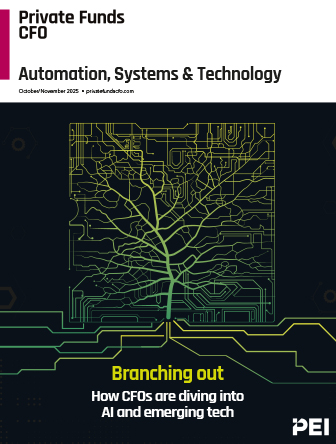
Technology and artificial intelligence continue to reshape every aspect of private equity, including reinventing the back office
While AI dominates conversations in this data-driven industry and is quickly becoming part of every CFO’s toolkit, it is not the only technology that fund managers are exploring. As adoption accelerates, professionals must learn to leverage existing systems alongside AI. Automation is also transforming how LPs and GPs collaborate. Despite these advances, many firms remain cautious, taking a ‘wait-and-see’ approach – particularly when it comes to applying AI in legal and compliance functions. This special report examines how advances in technology are making impact on the private funds industry.
INSIDE THE REPORT

For private funds, is it really all about AI?
The potential and risks of using artificial intelligence are being discussed in every sphere, but in the data-heavy world of private fund management, it is not the only tech innovation to think about.

Five reasons automation and new technologies are top of mind for...
Read Private Funds CFO's Special Report to see how AI, blockchain and other innovations are changing how the private equity industry operates.

Aztec Group on why experience matters for investors
Read Private Funds CFO's Special Report to see how AI, blockchain and other innovations are changing how the private equity industry operates.

Juniper Square on AI’s outsized impact
Read Private Funds CFO's Special Report to see how AI, blockchain and other innovations are changing how the private equity industry operates.

Automated fund monitoring is rewiring the LP-GP relationship
Read Private Funds CFO's Special Report to see how AI, blockchain and other innovations are changing how the private equity industry operates.

CSC: Modernizing fund ops without losing control
Read Private Funds CFO's Special Report to see how AI, blockchain and other innovations are changing how the private equity industry operates.

AI too risky for some legal and compliance tasks
Read Private Funds CFO's Special Report to see how AI, blockchain and other innovations are changing how the private equity industry operates.

FIS: Embracing tech to break down boundaries
Read Private Funds CFO's Special Report to see how AI, blockchain and other innovations are changing how the private equity industry operates.

AI impact on talent
Read Private Funds CFO's Special Report to see how AI, blockchain and other innovations are changing how the private equity industry operates.
DOWNLOAD THE MAGAZINE
LATEST AI STORIES








PREVIOUS REPORTS
AI, blockchain and other innovations are changing how the private equity industry operates.
The world of private equity is increasingly embracing transformative technology, from artificial intelligence to automation, blockchain and advanced data platforms. It’s a radical departure from some of the industry’s established ways of working. But while the time-, cost- and labor-saving efficiencies up for grabs are undoubtedly appealing, these tools also raise some significant challenges, not least in terms of governance structures and ensuring cybersecurity protocols are bulletproof. For some fund leaders, it’s bound to open up a whole new set of considerations.

Stepping into the age of transformative tech
From automation and artificial intelligence to blockchain, PE firms are increasingly implementing advanced technologies.

SEI on delegating data stewardship
The stakes couldn’t be higher for GPs looking to ensure their data is secure and accurate. That’s precisely why they should resist bringing more data management responsibilities in-house, says SEI's Christopher Edwards.

The rise of integrated vigilance in cybersecurity
CFOs are addressing today’s cybersecurity risks by fully integrating their technology, compliance and governance efforts as part of a holistic defense strategy.
As the private funds industry increasingly moves towards widescale automation within the back- and middle-office, the potential of artificial intelligence integration is has captured the imagination of fund leaders. In this special report, we explore how AI is being adopted into fund processes and the hurdles faced by the managers on this front, as well as how GPs are navigating the complexities of modern data management processes.

Jersey Finance on transitioning to tokenization
The digitalization of real assets will present a unique opportunity for jurisdictions that can remain competitive on technology and regulation, according to Elliot Refson and Philip Pirecki of Jersey Finance.

Artificial intelligence moves up the private funds agenda
AI technology is becoming a must-have, rather than a nice-to-have, in an increasingly competitive private funds market.

Explainable AI will blaze a trail in fund administration
Developments in artificial intelligence will rely on improvements in accuracy, reliability and transparency, writes Hebbia's George Sivulka.

PFA Solutions on how automation can ease the carry and compensation burden
Automated carry management systems can help private funds navigate an increasingly complex macroeconomic climate and improve talent retention by providing transparency, says Richard Change of PFA Solutions.

Charting the future of AI
Managers have mixed opinions on which areas of private funds management will most benefit from artificial intelligence technology, according to Private Funds CFO’s latest Private Fund Leaders Survey.
From artificial intelligence to automated waterfall processes, in this special report we examine how advances in technology are making their presence felt in the private funds industry.


No one can afford to be left behind, which is why demand for automated systems is growing rapidly. But robotic process automation isn’t just about augmenting what’s being done. In some cases, it’s freeing up teams from spending countless hours at repetitive tasks so that the brain trust of the private markets can be focused where human capital is most effective.
If technology can be trusted to take the wheel on those tasks that are more suited to a digital mind than a human one, people can be fully engaged in cultivating the relationships that are core to private markets. Are robots, automation and technology perhaps paving the way for a more human future?


